|
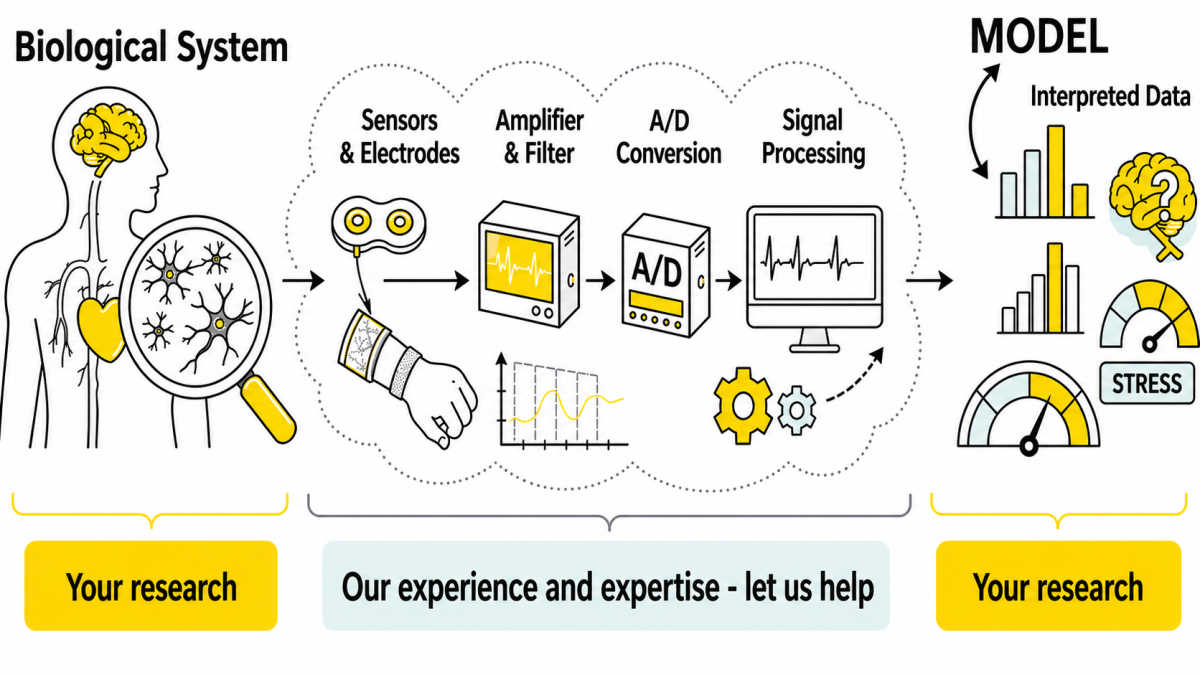
In many research projects, the scientific questions and intended experimental inferences are conceptually defined at the level of the research field. The major challenge is often to translate those goals into concrete measurement requirements: what must be captured at the sensor and electrical signal level, how those signals must be amplified, calibrated, processed, and synchronised, and how they must ultimately be transformed into data that support the intended scientific inferences.
Even for experienced researchers, translating research goals into practical requirements for sensors, amplifiers, data acquisition, signal processing, and software can be a significant technical challenge.
A common strategy is to break an overall requirement into many smaller parts and solve them separately, sometimes by different people, without keeping the full technical system constraints in view. But when those parts are later brought together in the final project, important requirements for synchronisation, interfacing, or electrical signal compatibility may be missing.
It is also easy to overlook long-term development, flexibility and scalability. A good lab system should be easy enough to use, adapt, and reconfigure within the research team itself. This reduces dependence on external specialists such as programmers or electrical engineers and makes the system more useful over time.
This is one of the reasons BIOPAC is so valuable in research environments. The BIOPAC research system makes multimodal data acquisition easier to implement, coordinate, and expand over time.
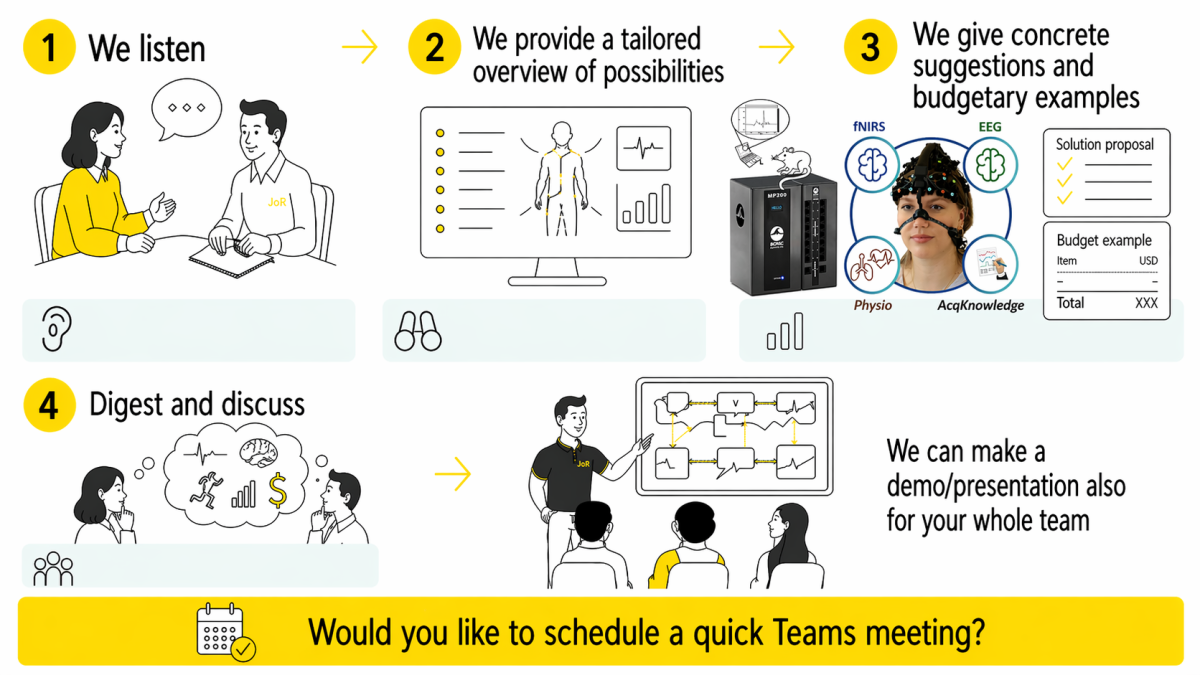
At JoR, we help research teams move from an initial idea to a clearer and more workable technical plan, while keeping the full system in mind. With BIOPAC, researchers can build flexible and expandable measurement setups around MP200 and AcqKnowledge, with time-synchronised data across multiple parameters and the possibility to extend into areas such as virtual reality, EEG, fNIRS, blood pressure, wireless acquisition, and education. |